Robust DC Motor
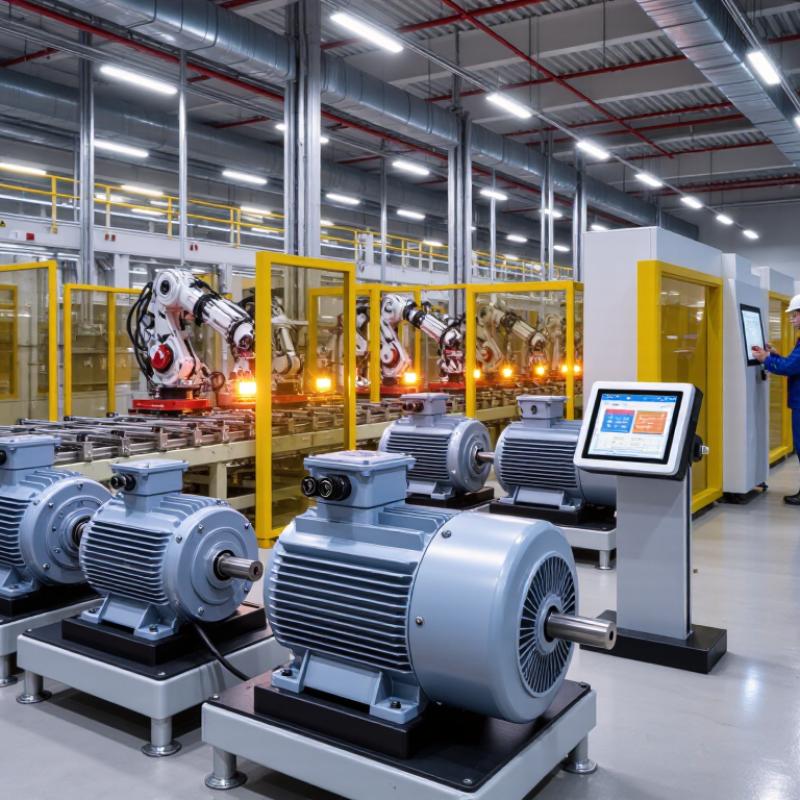
Smart Motors are becoming a practical priority for factories, warehouses, and commercial facilities worldwide. They combine efficient motor control, sensors, connectivity, and real-time performance data. This combination can reduce downtime, improve process visibility, and support more accurate maintenance decisions.
The International Energy Agency reports that electric motor systems consume a significant share of global electricity, especially across industrial applications. Its Energy Efficiency 2023 analysis also highlights efficiency improvements as an important route for reducing energy demand. Meanwhile, the U.S. Department of Energy continues to promote high-efficiency motor systems and improved variable-speed control for industrial users. These findings explain why global buyers are examining Chinese Smart Motors manufacturers more carefully.
China offers a broad manufacturing base, from compact servo motors to integrated drives for conveyor systems, pumps, robotics, and HVAC equipment. However, product variety can create confusion. A polished catalogue proves very little. Buyers should examine IEC compliance, rated efficiency, overload capacity, encoder accuracy, IP protection, communication protocols, and documented test results. A factory visit can reveal more than a sales presentation. Look at winding lines, balancing equipment, burn-in stations, and quality records.
No supplier is perfect.
Market forecasts from firms such as MarketsandMarkets indicate continued growth in connected motor technologies, although estimates differ by definition and region. That uncertainty deserves attention. This guide evaluates leading China Smart Motors manufacturers through engineering capability, production consistency, customization experience, export support, and after-sales reliability. The goal is not to praise every supplier. It is to help global buyers identify a dependable technical partner, not merely the lowest quoted price.
China’s smart motor manufacturing sector is responding to a measurable global efficiency problem. The International Energy Agency reports that electric motor systems consume more than 40% of worldwide electricity and nearly 70% of industrial electricity. This makes connected motor control commercially important, not merely convenient.
Market forecasts vary, but recent reports from Fortune Business Insights and MarketsandMarkets place the 2024 global smart motor market in the low-billion-dollar range. Their projections generally indicate annual growth of about 6% to 8% through 2030. Demand is strongest where factories need predictive maintenance, variable-speed control, and lower energy waste. Industrial buyers increasingly request motors with sensors, communication interfaces, and overload protection. The practical signal is clear.
Specification details still matter. A motor’s rated efficiency, torque curve, thermal class, ingress protection, and controller compatibility can affect operating cost more than its advertised intelligence. For example, a 30 kW motor running continuously may justify sensor integration quickly if vibration data prevents one unplanned shutdown. However, not every application needs a full digital platform. That point is often overlooked. Buyers should compare measured efficiency, service response, spare-parts availability, and tested performance under local voltage conditions. Forecasts remain imperfect, and market reports use different definitions of “smart motor.” Careful procurement therefore requires factory documentation, independent testing where practical, and clear communication about the intended duty cycle.
Regional electricity demand is a useful macro indicator for smart motor applications because motors are widely used in industrial production, HVAC systems, pumps, compressors, and automated equipment. The chart shows the International Energy Agency’s projected average annual electricity demand growth for 2024–2026, highlighting stronger expansion in China and the global market.
Source: International Energy Agency, Electricity 2024 report. Values represent projected average annual electricity demand growth for 2024–2026.
For global buyers, China’s smart motor manufacturers increasingly use IEC 60034-30-1 efficiency classes as a practical performance reference. IE3, IE4, and IE5 indicate progressively lower motor losses under defined testing conditions. The difference is not cosmetic. A motor operating thousands of hours can turn small efficiency gains into measurable energy savings.
IE3 is often the dependable baseline for industrial equipment. IE4 reduces losses further through improved magnetic materials, rotor design, and manufacturing control. IE5 targets ultra-high efficiency, but buyers should check whether the declared class applies to the complete operating range. Some ratings are valid only at specific power, voltage, frequency, and load points. That detail matters.
Ask manufacturers for complete test reports, not only catalog percentages. Verify the test standard, tolerance, rated duty, cooling method, and bearing configuration. A smart motor may also include temperature sensors, vibration monitoring, and communication interfaces. These features support predictive maintenance, but they do not automatically improve IE efficiency. A variable-frequency drive can also change real-world performance through switching and partial-load losses.
In practice, the cheapest IE5 quotation may not deliver the lowest lifecycle cost. Copper content, service access, controls, and operating hours deserve equal attention. I have found that datasheets can look precise while leaving installation conditions unclear. That is a warning sign. Real efficiency needs evidence, repeatable testing, and honest discussion about application limits.
China’s smart motor manufacturers serve global buyers across compact actuators, industrial drives, and high-torque systems. Power selection should match the real load, not only the catalog rating. A 100 W motor may suit a conveyor sensor, while a 7.5 kW unit can handle demanding production equipment. Check starting torque, duty cycle, speed control, and thermal limits before comparing prices.
IP rating reveals how the motor may perform in actual environments. IP54 can protect against limited dust and water splashes. IP65 offers stronger dust protection and resistance to water jets. Outdoor machinery may require higher protection, but excessive sealing can increase heat retention. Ask for test reports, operating-temperature data, and sample inspection records. Factory claims deserve verification.
OEM scale separates flexible suppliers from high-volume producers. Large facilities often provide automated winding, balancing equipment, traceable testing, and stable component sourcing. Smaller factories may offer faster engineering changes and lower minimum orders. Neither option is automatically better. During audits, review production capacity, quality records, spare-part control, and communication speed. A polished showroom can hide weak process discipline. No scorecard is perfect. Buyers should test pilot units under realistic loads, including vibration, noise, repeated starts, and voltage variation. This practical step often exposes issues that datasheets miss.
| Smart Motor Product Category | Typical Rated Power | Common Voltage Options | Typical IP Rating | Motor Technology | Smart Control and Feedback | Typical OEM / ODM Scale | Best-Fit Applications | Key Buyer Verification Points |
|---|---|---|---|---|---|---|---|---|
| Smart BLDC Motor Modules | 10 W–1 kW | 12 V, 24 V, 36 V, 48 V DC | IP20–IP65 | Brushless DC motor with electronic commutation | Hall sensors, speed control, current limiting, optional CAN or RS-485 | Prototype to medium-volume production; custom winding and harness options are common | Fans, pumps, medical equipment, automation modules, small AGVs | Confirm continuous torque, peak torque, thermal derating, controller compatibility, and noise level. |
| Integrated Servo Motors | 50 W–5 kW | 24 V–80 V DC; 110 V–220 V AC bus systems | IP54–IP65 | Permanent-magnet synchronous or brushless servo motor | Encoder feedback, closed-loop positioning, EtherCAT, CANopen, Modbus, or pulse control | Medium to high-volume OEM programs with parameter customization and firmware support | Robotics, packaging machinery, CNC axes, pick-and-place systems | Check encoder resolution, repeatability, inertia matching, communication protocol, and tuning software. |
| Smart AC Induction Motors | 0.12–315 kW | 220 V, 380 V, 400 V, 415 V, 460 V, 480 V AC | IP55–IP66 | Squirrel-cage induction motor, usually paired with a variable-frequency drive | VFD speed control, thermal sensors, vibration monitoring, optional industrial networking | High-volume standard production with IEC frame and mounting customization | Conveyors, compressors, pumps, HVAC systems, industrial machinery | Verify IEC frame size, efficiency class, duty cycle, insulation system, bearing arrangement, and regional certification. |
| Smart Permanent-Magnet Motors | 0.75–250 kW | 220 V–690 V AC, depending on drive architecture | IP55–IP66 | Permanent-magnet synchronous motor with high-efficiency operation | Variable-speed drive, temperature sensing, encoder or sensorless control, remote diagnostics | Medium to high-volume industrial OEM production; custom shaft and flange designs available | Fans, pumps, compressors, elevators, energy-saving industrial drives | Compare efficiency at partial load, demagnetization protection, drive pairing, cooling method, and serviceability. |
| Smart Geared Motors | 6 W–10 kW | 12 V–48 V DC; 110 V–240 V AC | IP44–IP65 | BLDC, brushed DC, or AC motor combined with planetary, worm, or helical gearing | Limit switches, Hall feedback, encoder feedback, brake control, remote speed adjustment | Small to high-volume OEM batches; gear ratio, output shaft, and mounting are often configurable | Automatic doors, lifting systems, conveyors, valves, sun-tracking systems | Confirm output torque, backlash, duty cycle, gear ratio, self-locking behavior, and gearbox lifetime. |
| Smart Stepper Motors | 20 W–1.5 kW | 12 V–80 V DC | IP20–IP65 | Two-phase or three-phase hybrid stepper motor | Open-loop or closed-loop control, encoder feedback, stall detection, pulse and direction input | Prototype, small-batch, and high-volume OEM supply; standard NEMA and custom formats | 3D printers, laboratory equipment, textile machinery, positioning stages | Evaluate holding torque, resonance control, acceleration profile, missed-step protection, and driver matching. |
| Smart Linear Actuator Motors | 20 W–1.5 kW | 12 V, 24 V, 36 V, 48 V DC | IP54–IP69K | DC, BLDC, or AC motor driving a screw or belt-based linear mechanism | Position feedback, limit switches, overload protection, synchronized control, Bluetooth or CAN options | Small to high-volume OEM programs with stroke, force, connector, and controller customization | Healthcare beds, lifting columns, agricultural equipment, industrial automation | Verify force rating, stroke length, speed under load, duty cycle, retraction load, and ingress protection. |
| Explosion-Protected Smart Motors | 0.12–315 kW | 220 V–690 V AC | IP55–IP66 | Certified induction or permanent-magnet motor with protected enclosure | Temperature monitoring, vibration sensors, VFD compatibility, industrial condition monitoring | Project-based and medium-volume OEM supply; configuration depends on hazardous-area certification | Oil and gas, chemical processing, mining, grain handling, hazardous industrial zones | Request current certification, hazardous-zone classification, temperature class, cable-entry details, and service requirements. |
| Water-Resistant Smart Pump Motors | 0.25–75 kW | 220 V–480 V AC; 12 V–48 V DC for compact systems | IP55–IP68 | BLDC, permanent-magnet, or induction motor integrated with a pump system | Pressure and flow feedback, dry-run protection, overcurrent protection, remote monitoring | Medium to high-volume OEM production with customized impeller, housing, and control parameters | Water treatment, circulation systems, HVAC, aquaculture, agricultural irrigation | Check hydraulic operating range, efficiency curve, seal material, corrosion resistance, and dry-run performance. |
| Low-Noise Smart Fan Motors | 5 W–3 kW | 12 V–48 V DC; 110 V–240 V AC | IP20–IP65 | EC motor, BLDC motor, or shaded-pole motor for air movement | 0–10 V, PWM, Modbus, temperature control, tachometer output, fault alarms | High-volume OEM manufacturing with customized impellers, housings, connectors, and firmware | HVAC, refrigeration, data centers, air purifiers, electronic cooling | Compare airflow, static pressure, sound power, speed range, thermal protection, and electromagnetic compatibility. |
| Customized OEM Smart Motor Assemblies | Application-dependent | DC or AC voltage selected according to system design | IP20–IP69K | BLDC, servo, induction, permanent-magnet, or geared motor architecture | Embedded controller, encoder, wireless gateway, PLC integration, cloud monitoring, custom firmware | From engineering samples to mass production; tooling, validation, packaging, and after-sales support may be included | Industrial equipment, appliances, mobility systems, robotics, renewable-energy devices | Assess engineering resources, sample lead time, production capacity, quality system, testing capability, and change-control process. |
China Best Smart Motors Manufacturers for Global Buyers
Factory evaluation should begin with evidence, not catalog claims. ISO’s 2022 Survey recorded about 1.26 million ISO 9001 certificates worldwide, yet certification alone cannot prove stable motor quality. Buyers should inspect the certificate scope, audit history, corrective actions, and process records. A useful factory visit follows one motor from incoming copper wire to final packing. Check torque readings, insulation tests, calibration labels, and serial-number traceability. Small gaps matter.
IEC testing must match the intended application. IEC 60034-2-1 defines methods for determining motor losses and efficiency, while IEC 60034-30-1 classifies efficiency levels. Ask for recent third-party or witnessed test reports, including voltage, frequency, load, temperature, and measured efficiency. The IEA has estimated that electric motor systems consume roughly 53% of global electricity, making efficiency data commercially important, not decorative. Test conditions are sometimes unclear.
Production capacity needs harder proof. Request twelve-month output records, monthly capacity, utilization rates, workforce levels, and average lead times. Compare claimed capacity with raw-material storage, test-bench numbers, and shipment history. Capacity figures can be optimistic. I would not rely on one factory tour or one impressive sample. Repeat audits, random inspections, and production-trial data provide a more reliable view, although they still cannot remove every supply risk.
Global buyers should treat compliance as a design requirement, not a final paperwork step. The International Energy Agency reports that electric motor systems consume roughly half of global electricity. Small efficiency gains therefore matter at factory scale. For smart motors, request CE documentation, the EU Declaration of Conformity, and testing against applicable machinery, low-voltage, and EMC requirements. CE is a declaration of conformity, not a universal quality certificate. That distinction is often missed.
UL requirements depend on the destination, installation, and product category. A recognized safety evaluation can support North American procurement, but buyers should verify the exact standard and certification scope. RoHS evidence should cover restricted substances in the motor, controller, cables, and soldered assemblies. EMC testing must examine both emissions and immunity. A motor that passes in a quiet laboratory may behave differently beside a variable-speed drive. Real installations are less polite.
Energy performance also needs measurable proof. IEC 60034-30-1 defines efficiency classes for many motor types, while the European Commission’s Ecodesign Regulation 2019/1781 sets efficiency requirements for covered motors and drives. Ask for rated-load efficiency, standby consumption, test conditions, and firmware version. The U.S. Department of Energy notes that motor systems represent a major share of industrial electricity use. A certificate alone is not enough. Sample testing, traceable serial numbers, and an audit of the technical file reduce risk. Some suppliers provide impressive PDFs, yet omit the controller’s EMC report. That gap deserves a second question.
They indicate progressively lower motor losses under defined testing conditions. Higher classes can reduce energy costs. Testing conditions still matter.
Not necessarily. Verify performance across the complete operating range, not only one rated load. The cheapest quote may not provide the lowest lifecycle cost.
Request full test reports, rated duty, voltage, frequency, load points, cooling method, and tolerance. Catalog percentages are not enough. Evidence matters.
Match power to the real load, starting torque, duty cycle, speed range, and thermal limits. A catalog rating alone can mislead. Measure the application.
IP54 generally resists limited dust and water splashes. IP65 offers stronger dust protection and water-jet resistance. Higher sealing may retain more heat.
Review winding automation, balancing equipment, testing records, production capacity, and spare-part control. Inspect sample units under realistic loads. A polished showroom proves little.
No. Sensors and communication interfaces support monitoring and maintenance. They do not automatically raise efficiency. Controllers may add switching and partial-load losses.
Request conformity documents, safety evaluations, restricted-substance evidence, EMC test reports, and energy-performance data. Check the exact product scope. A certificate alone is not enough.
Test pilot units with repeated starts, vibration, noise, voltage variation, and realistic loads. Compare serial numbers with technical records. I might miss one installation detail, so review the results twice.
This guide examines China’s Smart Motors manufacturing sector through current market scope, global demand indicators, and key application trends in industrial automation, energy management, and connected equipment. It explains how IEC 60034-30-1 efficiency classes, including IE3, IE4, and IE5, help buyers compare energy performance, operating costs, and long-term value. It also outlines how manufacturers can be evaluated by motor power range, IP protection rating, customization capability, and OEM production scale.
For international buyers, the article presents a practical factory assessment framework covering ISO 9001 quality systems, IEC-based testing, production capacity, traceability, and after-sales support. It further highlights essential compliance checks for CE, UL, RoHS, EMC, and applicable energy-efficiency requirements in different markets. By combining technical benchmarks, manufacturing evidence, and certification reviews, buyers can identify reliable suppliers and select Smart Motors that deliver consistent performance, regulatory readiness, and efficient operation.